
The historic Sixty Dome Mosque in Bagerhat is facing increasing risk due to rising soil salinity and the impacts of climate change in the coastal region. This medieval structure is considered one of the most significant architectural heritages not only in Bangladesh but across South Asia.

A joint study conducted by Khulna University, National Geographic Society, and ICOMOS reveals that rising temperatures, industrial pollution, excessive monsoon humidity, and increasing groundwater salinity are accelerating the deterioration of the mosque.
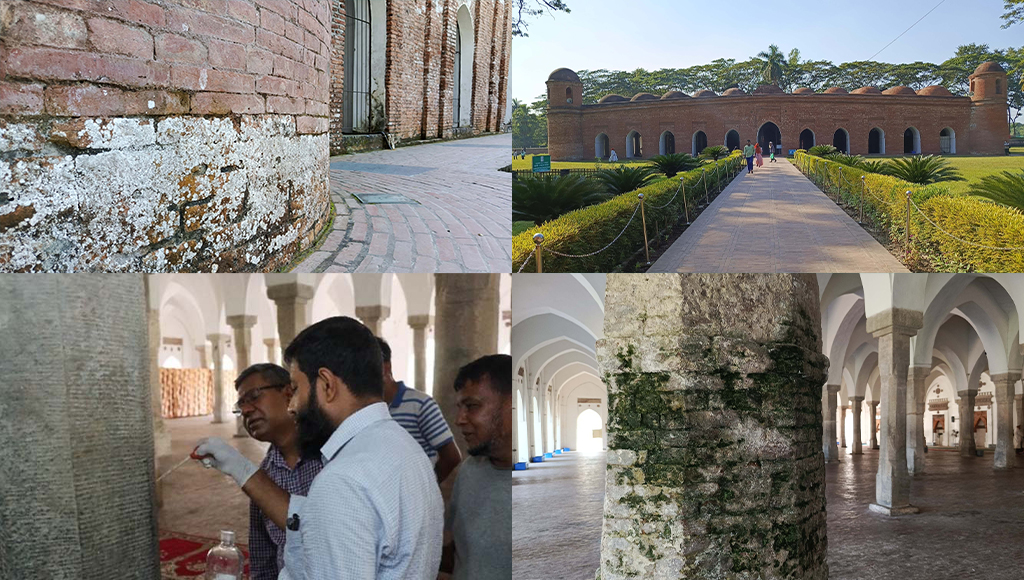
Experts say that sea-level rise, cyclones, storm surges, saline groundwater, and high humidity are gradually weakening the structure. Visible damages now include cracks in walls, domes, pillars, and mihrabs, along with peeling lime plaster and the accumulation of white salt deposits.
The mosque was built in the 15th century by the Sufi saint Khan Jahan Ali, following the Tughlaq architectural style of Delhi. It is currently recognized as a UNESCO World Heritage Site under UNESCO.
To ensure urgent preservation, the Department of Archaeology has formed a five-member expert committee led by former Director General Dr. Md. Shafiqul Alam. Investigations have revealed that the mosque’s mihrab is at risk of collapse at any time. Additionally, iron clamps used to hold stone blocks together have corroded, reducing their load-bearing capacity.
Further research indicates that saline water rising from below is forming salt crystals within the bricks, gradually weakening the structural bonds. Rising temperatures, pollution, and seasonal humidity are further accelerating the decay.
According to experts, the sandstone used in the mihrab and pillars is highly sensitive, making it particularly vulnerable to salinity damage. Some parts of the structure are already at risk of collapse.
In response, the Department of Archaeology has initiated conservation efforts. With support from UNESCO, detailed damage mapping is underway, and international experts are being engaged to strengthen preservation measures.
However, stakeholders warn that partial conservation efforts will not be sufficient. Without a comprehensive long-term strategy to address climate change impacts, the historic site may be added to the list of endangered World Heritage Sites in the future.
Regional Director Lovely Yasmin stated that a complete deterioration map of the mosque will be developed with UNESCO’s assistance, and conservation work will begin promptly with the involvement of international experts. UNESCO Dhaka has also recommended immediate temporary protection measures.
Meanwhile, experts caution that it is not only the Sixty Dome Mosque—many mosques, temples, and archaeological sites across Bangladesh’s coastal regions are similarly threatened by salinity and climate change.