
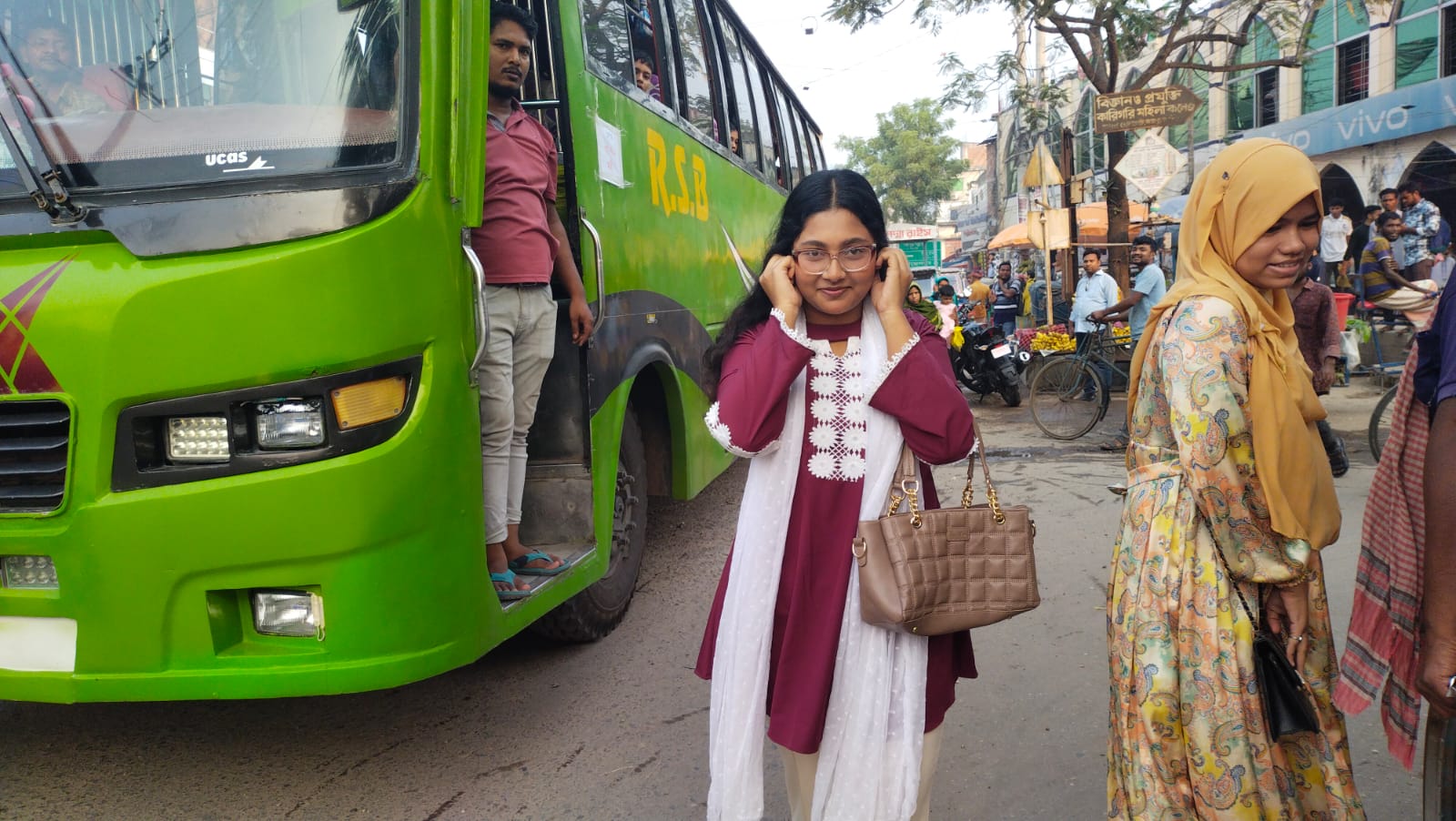
Moshiur Rahman Khan, Joypurhat :: Pedestrians in Joypurhat town are increasingly distressed by severe noise pollution, while residents of nearby residential areas are also unable to escape its impact. Questions are now being raised among the public regarding who is actually responsible for controlling this growing problem, as the administration appears to have taken no visible or direct action in many cases.

A field observation conducted by The Daily Inqilab for three to four consecutive days along the main road stretching from Joypurhat Bus Stand to Pachur Mor (Zero Point) revealed that the level of noise pollution significantly increases as the day progresses.
Heavy vehicles including inter-district buses, trucks, pickup vans from various companies, three-wheeler auto-rickshaws, and motorcycles frequently ply this road. It was observed that buses and motorcycles often use their horns unnecessarily and indiscriminately, creating serious inconvenience for pedestrians. Children and students travelling to primary and secondary schools are particularly affected both physically and mentally.
According to medical science, sound levels between 40 to 50 decibels are considered tolerable for the human body. However, when the sound level rises from 60 to 120 decibels, it becomes extremely harmful. Such intense noise directly affects the human nervous system. Experts warn that exposure to 60–65 decibels of sound may temporarily impair hearing, while prolonged exposure above 70 decibels may lead to permanent hearing damage and serious neurological problems.
According to the Noise Pollution (Control) Rules, 2006 of Bangladesh, under Rule 18, violators of the law may face one month’s imprisonment or a fine of Tk 5,000, or both, for the first offense. For repeated offenses, the punishment may increase to six months’ imprisonment or a fine of Tk 10,000, or both.
Medical experts also warn that loud noise can trigger serious health complications for patients suffering from heart disease and high blood pressure.
It is often seen that groups of motorcyclists ride through different streets of the town, repeatedly blowing horns for amusement. As a result, pedestrians and residents of residential areas remain anxious and disturbed.
Irene Sultana Suma, a guardian of a student of Jaman Pre-Cadet School, said,
“When I take my child to school and bring him back, I often cover his ears with my hands. The sudden loud horns frighten me; I cannot imagine how much it affects my child. Strict action should be taken against unnecessary horn use.”
Abu Raihan, a resident of Notunhat, said, “As a conscious citizen, I want to say that the amount of noise pollution caused by locally modified vehicles (Bhutbhuti) coming to the cattle market every Saturday is alarming. If this continues, many residents of this area may soon suffer hearing problems. Under which law have these auto-vans and Bhutbhutis installed horns? This is my question to the administration.”
When asked about unnecessary horn use, a driver of SR Paribahan bound for Dhaka declined to comment. However, a bus driver from Bogura said that horns are sometimes used due to traffic congestion.
Md. Alal Hossain, a resident of Dasra Khanpara in Khetlal upazila, said at Pachur Mor, “Only the administration can control unnecessary horn use. Ordinary citizens have little power to stop it.”
Md. Omar Ali Babu, a media worker and social activist in Joypurhat, stated that responsibility does not lie solely with the administration.
“The authorities must enforce the law, but citizens must also become more aware and responsible.”
Md. Nuruzzaman Liton, Lecturer of the Bangla Department at Joypurhat B.Ed. College, said that trained and environmentally conscious drivers are essential for controlling noise pollution, and it is the responsibility of the state to ensure such training.
Advocate Mohammad Arafat Hossain of Joypurhat Judge Court emphasized the importance of public awareness and visible enforcement.
“Public awareness must be increased first, and traffic police should ensure visible punishment for offenders. This will help reduce the tendency of unnecessary horn use.”
Nur Alam, President of the Joypurhat district unit of Nirapad Sarak Chai (We Demand Safe Roads), said noise pollution has now become a serious social problem.
“Even in places where horns are prohibited, drivers continue to blow them. Residential areas are also experiencing severe noise pollution, and it is difficult to understand who is responsible for controlling it. The administration appears to be giving little importance to the issue.”
When asked about the health effects of noise pollution, Civil Surgeon Dr. Al Mamun of Joypurhat said prolonged exposure to loud noise primarily damages human hearing ability.
“Children and elderly people are the most vulnerable. Excessive noise can also cause migraines, chronic headaches, and may even lead to high blood pressure if exposure continues for a long time.”
When contacted, Joypurhat Superintendent of Police Mina Mahmuda told The Daily Inqilab, “I have not received any formal complaint regarding this matter before. Now that I have learned about it from you, necessary action will be taken.”
Meanwhile, Traffic Inspector Jamirul Islam of Joypurhat Sadar said that traffic police themselves suffer greatly due to noise pollution.
“In the past, strict measures were not taken in this regard, but now we will discuss the matter with higher authorities and take action according to the rules.”
However, when asked whether anyone had previously been punished for unnecessary horn use, he said he was not certain.