

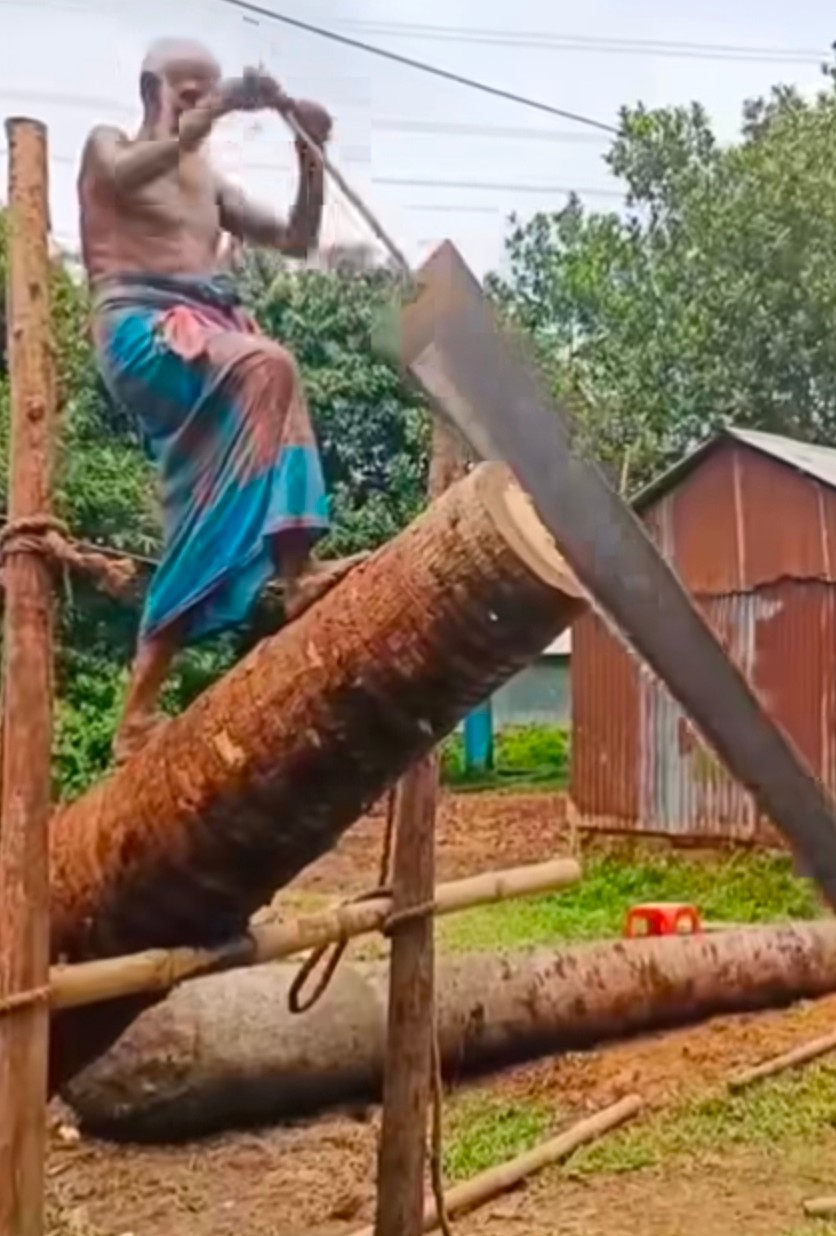


Md. Riazur Rahman Patuakhali :: Like all districts of South Bengal, Patuakhali has now completely disappeared from the sight of the sawmill workers cutting trees. With the evolution of time and the need for livelihood, they have changed their professions.
The people of the sawmill community lived in the rural areas of Baufal, Dashmina, Mirzaganj, Dumki, Rangabali and Kalapara under Sadar Upazila. Every year, when the dry season came, they would form groups in different districts and live for a month for the purpose of working as sawmill workers. Their profession was to go from village to village and take the work of cutting trees. At that time, the householders used to wait for the sawmill workers to cut trees. The sawmill workers have disappeared today as their ancestors left this profession and went to other profitable professions.
Nevertheless, some people still maintain this profession in some regions of the country for the need to earn a living. Even before the nineties, the boys of the neighborhood used to gather to watch the sawmillers cutting trees. They would join the sawmillers in the rhythm of the songs.
And the sawmillers would start work in the morning after eating jaggery and panta. At that time, three or four members of the sawmill team would be engaged in cutting trees, but one of them would be busy cooking. They would spend the entire season like this. After cutting down all the trees in the village in a few months, they would return home.
It is known that at that time, the sawmillers would cut trees by digging holes in the ground or making wooden structures and using a saw. At least two or more people were needed above and below to operate this type of saw. Various sizes of wood were cut from a tree by pulling it up and down with a handle-mounted saw. The beams and planks made were used to make roofs and various types of furniture. At that time, the sawmillers would charge a wage per square foot for cutting wood, depending on the size and type.
Cutting and sawing a medium-sized tree used to cost one to one and a half thousand taka. And it took more than three days. Nowadays, the sawmills of rural Bengal are disappearing due to the rise of modernity.
There is now a wave of mechanical sawmills in the villages. Sawmills in various markets are cutting wood according to demand in a short time at very low cost. At the same time, the demand for furniture has increased due to the increase in the demand for mechanical sawmills.
Munshi Billal, a senior sawmiller who came to work from Khepu Para, told the daily Janabani Pratibid, “We have been involved in this profession for 50 to 60 years. Earlier, my father used to do this work. I have been doing this work since my father’s death. However, it is no longer possible to survive solely on this profession.”
Shamsul, a sawmiller from Rangabali Upazila, said, “Earlier, I used to work with my grandfather, but now I have given up the profession because a modern sawmill has been established.”