

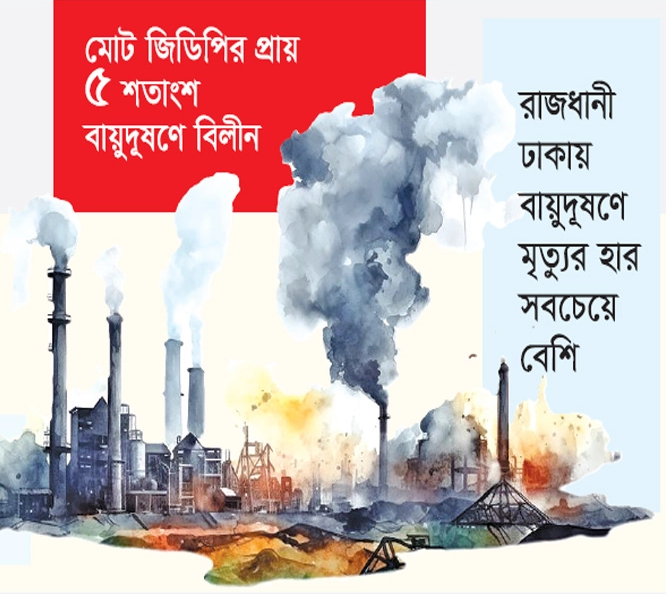


Air pollution in Bangladesh is no longer merely an environmental concern; it has emerged as a silent public health crisis that is claiming thousands of lives while inflicting severe damage on the country’s economy. According to a recent study, exposure to fine particulate matter (PM2.5) causes approximately 88,240 premature deaths every year in Bangladesh—equivalent to an average of 242 deaths every day. The study also estimates that air pollution results in an annual economic loss of nearly Tk 280,000 crore (approximately US$23 billion), representing around 5 percent of the country’s Gross Domestic Product (GDP).

These alarming findings were revealed in a study conducted by the Department of Public Health and Informatics at Jahangirnagar University (JU). The research, titled “The Economic Cost of Air Pollution in Bangladesh: A Health and Economic Impact Analysis,” was recently published in the internationally recognized journal Pollution. It identifies air pollution as one of the country’s most pressing public health challenges.
The study analyzed data collected over a nine-year period from 2013 to 2021, examining air quality, health statistics, and economic impacts across Bangladesh’s six major cities—Dhaka, Chattogram, Rajshahi, Khulna, Sylhet, and Barishal. The research was led by Dr. Md. Sakhawat Hossain, Chairman and Associate Professor of the Department of Public Health and Informatics at Jahangirnagar University.
According to the study, PM2.5—fine particulate matter with a diameter of less than 2.5 micrometers—is the most hazardous air pollutant. These microscopic particles penetrate deep into the lungs and enter the bloodstream, significantly increasing the risk of cardiovascular disease, stroke, chronic respiratory illnesses, lung cancer, kidney disease, diabetes-related complications, and other inflammatory disorders.
The researchers found that among the estimated 88,240 annual premature deaths linked to air pollution, 37,519 were attributed to cardiovascular diseases, 8,344 to chronic respiratory diseases, and 811 to lung cancer. The remaining 41,566 deaths were associated with conditions such as stroke, pneumonia, hypertension, kidney-related complications, and other illnesses aggravated by prolonged exposure to air pollution.
City-wise analysis showed that Dhaka bears the heaviest burden, with 68,703 premature deaths linked to PM2.5 exposure. The corresponding figures for other cities are 11,202 in Chattogram, 2,827 in Rajshahi, 2,625 in Khulna, 1,488 in Sylhet, and 1,395 in Barishal.
Beyond its devastating health impacts, air pollution is placing a heavy burden on Bangladesh’s economy. The study estimates annual economic losses of approximately Tk 280,000 crore, driven by rising healthcare costs, reduced labour productivity, premature deaths among the working-age population, and lost working hours. The total economic burden is estimated at nearly 5 percent of the country’s GDP.
The researchers warn that without immediate and effective interventions, air pollution will continue to strain the healthcare system while significantly undermining Bangladesh’s long-term economic growth.
Lead researcher Dr. Md. Sakhawat Hossain said, “Air pollution should no longer be viewed solely as an environmental issue. It has become a major public health and economic crisis. The loss of nearly 88,000 lives annually and economic damages amounting to about five percent of GDP are deeply alarming. Without decisive action, the situation will become even more severe in the years ahead.”
To address the crisis, the study recommends strict implementation of the World Health Organization (WHO) air quality guidelines, tighter regulation of emissions from brick kilns and industries, reduction of vehicular pollution, adoption of integrated urban air quality management policies, and stronger public awareness alongside coordinated action by government and non-government stakeholders.