
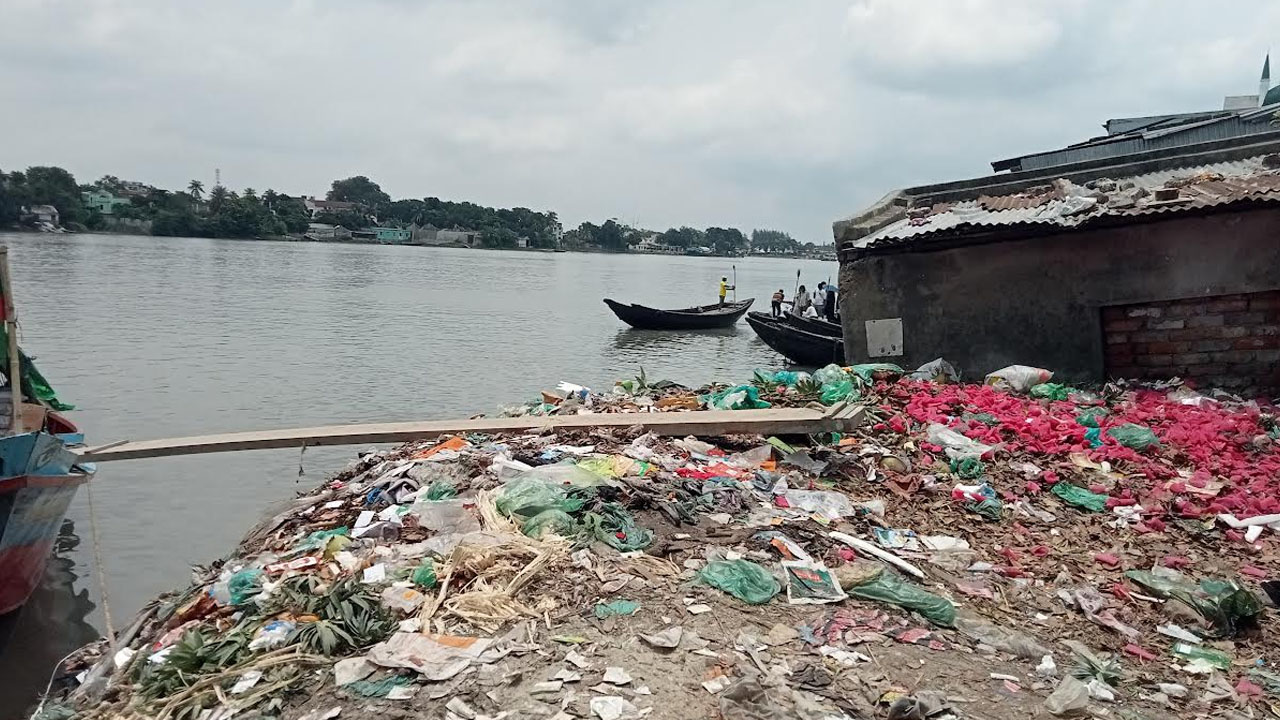


Once, people bathed, cooked, and even drank water from the Rupsha and Bhairab rivers. Today, standing near these rivers has become difficult because of the foul smell, polluted water, floating plastic waste, market garbage, and untreated industrial effluents. The two major rivers of Khulna are gradually losing their vitality as pollution continues to rise. Fish production is declining, aquatic biodiversity is under severe threat, and the livelihoods of thousands of river-dependent families are becoming increasingly uncertain. Environmental experts warn that without immediate and effective intervention, the Rupsha and Bhairab could eventually turn into ecologically dead rivers.

Residents allege that huge volumes of municipal sewage and household waste are discharged directly into the rivers every day through the city’s drainage system. Untreated industrial wastewater, market refuse, plastic, and polythene waste further worsen the situation. Years of unchecked pollution have significantly deteriorated the quality of river water.
Shahidul Islam, a fisherman from Bagmara in Rupsha Upazila, said there was a time when casting a net into the Bhairab River would yield a variety of fish. “Now, even after spending hours on the river, we catch only a fraction of what we used to. Pollution has destroyed the natural breeding grounds of fish,” he said.
Ruby Begum, a resident living along the Rupsha River, recalled that the river water was once clean and usable for daily household activities. “Today the water has changed color, and the foul odor makes it difficult even to stand near the river,” she said.
Shamim Hawladar of Naihati said demand for river fish remains high, but fish stocks have declined sharply. “Fishermen are struggling to earn a living, while consumers are increasingly deprived of locally caught freshwater fish,” he added.
Dr. Nazia Hasan, Professor of Environmental Science at Khulna University, said untreated domestic sewage, market waste, plastic, polythene, and other biodegradable and non-biodegradable wastes are being dumped directly into the rivers. She added that untreated industrial effluents, along with chemical fertilizers and pesticides washed off agricultural land, are also contributing significantly to river pollution.
According to Dr. Hasan, heavy metals and toxic chemicals present in polluted river water accumulate in fish tissues. “When people consume contaminated fish, these toxic substances enter the human body, increasing the risk of cancer, infertility, and several other serious health complications,” she warned.
Environmental expert and Khulna University professor Dr. Md. Salauddin said numerous commercial establishments, industries, and restaurants have been built along the banks of the Rupsha and Bhairab rivers. Many of them discharge wastewater directly into the rivers. In addition, solid waste from major markets, including Borobazar, is frequently dumped into the waterways.
He also noted that although Khulna’s Master Plan identifies 49 canals, most have been encroached upon, filled up, or heavily polluted. Illegal fish farming and unauthorized construction have disrupted the natural flow of many canals, further worsening the region’s drainage and environmental conditions.
Kazi Mahfuzur Rahman (Mukul), Divisional Coordinator of the Bangladesh Environmental Lawyers Association (BELA) in Khulna, said industrial waste, municipal sewage, and plastic pollution remain the principal sources of river contamination. He observed that despite the worsening situation, there has been little visible or effective legal action to protect the Rupsha River from pollution and encroachment.
Environmentalists believe that restoring the rivers will require strict enforcement of environmental laws, mandatory operation of Effluent Treatment Plants (ETPs) in all industries, modern sewage management systems, proper solid waste disposal, and the removal of illegal encroachments from rivers and canals.
Khondkar Md. Fazlul Haque, Director of the Department of Environment, Khulna Division, said the department monitors river water quality every month. According to test results, water quality generally remains within acceptable standards during the monsoon season but often falls below the required standards during the dry season.
He added that legal action is regularly taken against industries operating without environmental clearance or licenses, including filing cases when necessary. “If any individual or institution is found polluting the rivers, appropriate action is taken following investigation,” he said.
Mohammad Masud Parvez, Deputy Director of the Khulna River Port under the Bangladesh Inland Water Transport Authority (BIWTA), said the authority has identified more than 900 illegal structures along the riverbanks. The list is being updated in coordination with the district administration, and eviction drives will be carried out in phases once the final list is completed.
Environmentalists warn that the Rupsha and Bhairab are not merely waterways; they are vital to Khulna’s ecology, economy, fisheries, transportation, and the livelihoods of hundreds of thousands of people. Without immediate and coordinated action, preserving these historic rivers for future generations may become an impossible task.