

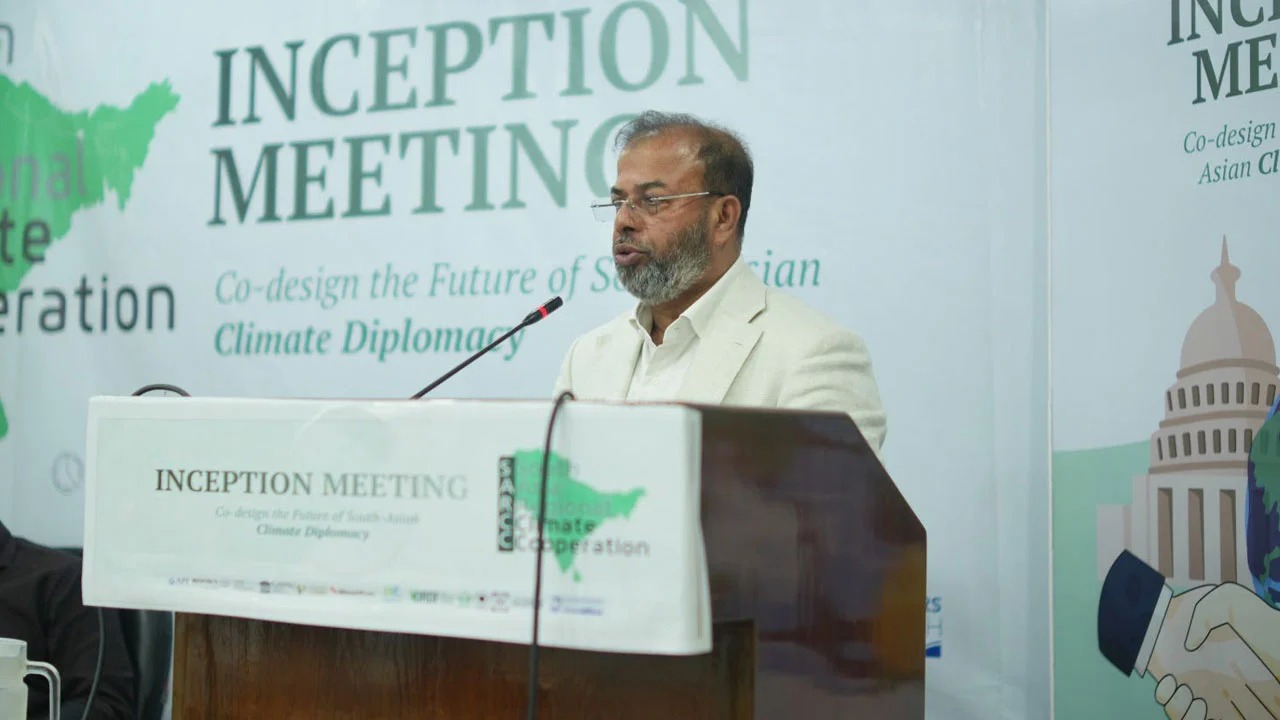


South Asian countries must strengthen regional cooperation to address the growing risks of climate change and protect the environment, State Minister for Forest, Environment and Climate Affairs Sheikh Faridul Islam has said.

“Climate change is no longer a problem for any single country. Its impacts are crossing national borders,” he said, urging policymakers to work in a coordinated manner with neighbouring countries.
The state minister made the remarks on Monday at a meeting of the South Asia Regional Climate Cooperation (SARCC) held at the CIRDAP Auditorium in Dhaka. The meeting was organised under the theme “Co-Design the Future of South Asian Climate Diplomacy.” Climate experts, policymakers, researchers, development professionals, journalists and youth representatives attended the event.
Sheikh Faridul Islam said the government has undertaken various initiatives to address climate risks and protect the environment, including a programme to plant 250 million trees and measures to control environmental pollution.
He said South Asian countries are facing various environmental disasters and Bangladesh is no exception. Regional cooperation should therefore be strengthened on issues ranging from ensuring a fair share of transboundary river waters to addressing cross-border environmental challenges.
The state minister stressed that rivers cannot be protected through discussions or projects alone unless the sources of pollution are stopped. “It will be difficult to protect the Buriganga, Shitalakkhya, Turag and Balu rivers unless the sources of pollution are addressed,” he said, adding that the government is taking various initiatives to prevent pollution outlets from discharging waste into rivers.
Speaking as a special guest, Prime Minister’s Special Assistant for Environment, Forest and Climate Change Dr Md Saimum Parvez said SAARC and BIMSTEC should be made more active in addressing climate risks.
“Climate change is no longer a problem of a single country; it is a transboundary issue,” he said, stressing that political will is crucial to addressing such challenges.
He also called for stronger climate diplomacy and urged countries to resolve disputes through dialogue rather than confrontation. “There should be no hostility towards any country; instead, we must find solutions through discussion,” he said.
Waterkeepers Bangladesh Coordinator Sharif Jamil called for stronger government initiatives at the regional level to address climate, water and river-related challenges in South Asia.
He said bilateral discussions alone would not be sufficient to resolve the crisis surrounding transboundary river management and called for broader engagement with other relevant countries.
Speakers at the meeting said transboundary air pollution is becoming an increasingly serious concern for Bangladesh. They stressed the need to strengthen bilateral and regional relations with Asian countries to address the issue.
They also called for greater cooperation on renewable energy, green connectivity, knowledge and technology exchange, as well as stronger joint bargaining capacity for international climate finance.
Prof Dr AKM Saiful Islam of the Institute of Water and Flood Management at Bangladesh University of Engineering and Technology (BUET) presented the keynote paper at the event.
He said climate change is no longer a future threat but has become part of the present development reality in South Asia. Heatwaves, floods, cyclones, droughts, irregular rainfall, changes in glaciers and sea-level rise are increasingly crossing national borders.
He stressed that coordinated, regional and forward-looking initiatives are essential to address these risks, alongside stronger cooperation among South Asian countries and more effective climate diplomacy.
Senior journalist Habib Rahman delivered the opening remarks. Advocate MA Mukit, Chairman of the Human Safety Foundation, and Mir Mohammad Ali, Assistant Professor at Sher-e-Bangla Agricultural University, also participated in the thematic discussions.
Other speakers included Md Ashrafuzzaman Khan, Coordinator of the Climate Change Programme at CCD Bangladesh; Sarwar Alam Dipu, Programme Manager at IUCN Bangladesh; Mahmudul Hasan Tarek, Head of the Water, Food and Climate Programme at Helvetas Bangladesh; Sharmin Nahar Nipa, Assistant Director of the Centre for Climate Change and Environmental Research at BRAC University; and Prof Dr Kamruzzaman Majumder, Chairman of the Centre for Atmospheric Pollution Studies.
Mohammad Ali Shaheen, Head of Advocacy at Young Power in Social Action; environmental and climate expert Dr Hasib Md Irfanullah; and SM Manzur Rashid, Director of Unnayan Onneshan, also took part in the discussions.
The meeting concluded with a strong call for coordinated regional action to strengthen climate diplomacy, improve transboundary river management, control cross-border air pollution, promote renewable energy and technology exchange, and address the multidimensional risks posed by climate change across South Asia.