
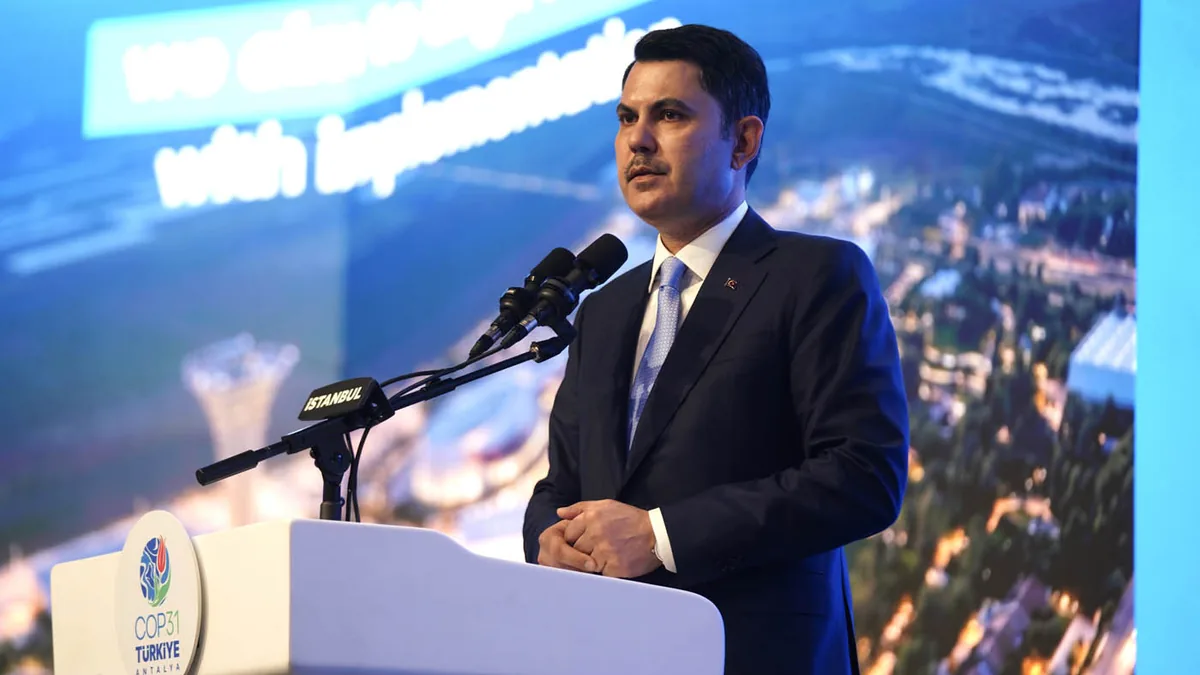


COP31 President-Designate Murat Kurum has called on world leaders to demonstrate stronger political will and significantly increase climate finance, warning that the widening gap between global climate investment needs and actual funding represents a “chasm” that must urgently be closed.

Speaking at the first day of the Istanbul Climate Finance Summit (ICFS), Kurum urged governments, financial institutions and private investors to treat climate finance as a strategic investment and a matter of global security, rather than simply a cost.
“Today, we issue a clear call to leaders around the world: the time has come to show stronger, bolder and more concrete political will on climate action,” Kurum said.
He called for greater resources to be directed towards clean energy, electrification, resilient cities and green industry, while urging countries to unite behind efforts to accelerate the global transition to a low-carbon and climate-resilient economy.
Kurum highlighted the scale of the global financing challenge, saying climate finance needs are estimated at between $7.5 trillion and $9 trillion annually, while current global investment stands at around $1.9 trillion.
“I call that difference a chasm, and it is a chasm we must close,” he said.
The COP31 President-Designate also drew a comparison between climate investment and defence spending, arguing that climate security should receive a similar level of strategic attention.
“The world is redefining what security means,” Kurum said, pointing to plans by NATO countries to increase defence-related investment to as much as 5 percent of GDP.
“We expect to see ambition on a similar scale when it comes to climate security,” he added.
According to Kurum, both defence and climate spending represent investments made today to protect societies from future threats.
“If we no longer have a safe world to live in, what purpose will all our spending to defend our countries serve?” he asked.
He stressed that the ultimate challenge is not only to protect countries from conventional threats but also to ensure that future generations inherit a liveable planet.
“The real challenge is not simply to defend our countries. It is to leave future generations a liveable world that is worth defending,” Kurum said.
The Istanbul Climate Finance Summit is bringing together private banks, international financial institutions, multilateral development banks, multilateral climate funds, institutional investors and other financial actors to explore ways of scaling up climate finance ahead of COP31, which will take place in Antalya, Türkiye, from Nov. 9 to 20, 2026.
Finance has been identified as a central priority of the COP31 Presidency, with the Turkish presidency seeking to rebuild confidence in the international climate process while translating climate commitments into concrete action.
A major development announced at the summit was the operationalization of the Climate Implementation Bridge (BRIDGE), a flagship COP31 Presidency initiative designed to help close the gap between climate ambitions and the deployment of capital.
The United Nations Development Programme (UNDP) has been named as BRIDGE’s delivery partner. The initiative will provide country-driven implementation support to help governments transform climate and development priorities into finance-ready portfolios of projects.
The involvement of UNDP is expected to allow BRIDGE to draw on established delivery infrastructure across the UN system and provide implementation support more rapidly and effectively.
The summit also saw the unveiling of the Istanbul Declaration on Climate Implementation and Finance, endorsed by a broad group of development finance institutions, international financial institutions, multilateral development banks, climate funds, UN entities, national and local governments, city networks, private-sector representatives, institutional investors, commercial financial institutions and philanthropic organizations.
The declaration welcomes BRIDGE and calls for stronger cooperation among financial and development institutions to accelerate climate action.
Signatories also acknowledged the COP31 Presidency’s “35-by-35” electrification target, which seeks to increase electricity’s share of global final energy consumption to 35 percent by 2035.
The declaration calls for enhanced institutional and technical support, integrated urban financing mechanisms, technical assistance and stronger capacity-building networks. It also seeks greater coordination across COP31 and future climate Action Agendas, while encouraging regional and international financial centres to strengthen investment partnerships and mobilize capital for climate implementation.
Kurum said the Istanbul summit was intended to create a dedicated platform for financial actors to determine how they could support the COP31 Presidency’s priorities, including electrification, waste management, resilient cities and ocean-related climate action.
“COP needs to become a place where we can seize the opportunities of climate action and produce concrete outcomes that address the real challenges people face,” Kurum said.
“Finance is essential to this effort. Without finance, there is no implementation.”
With COP31 approaching, the Turkish presidency is seeking to place climate finance at the centre of negotiations and move the global climate agenda from commitments towards implementation, investment and measurable results.