
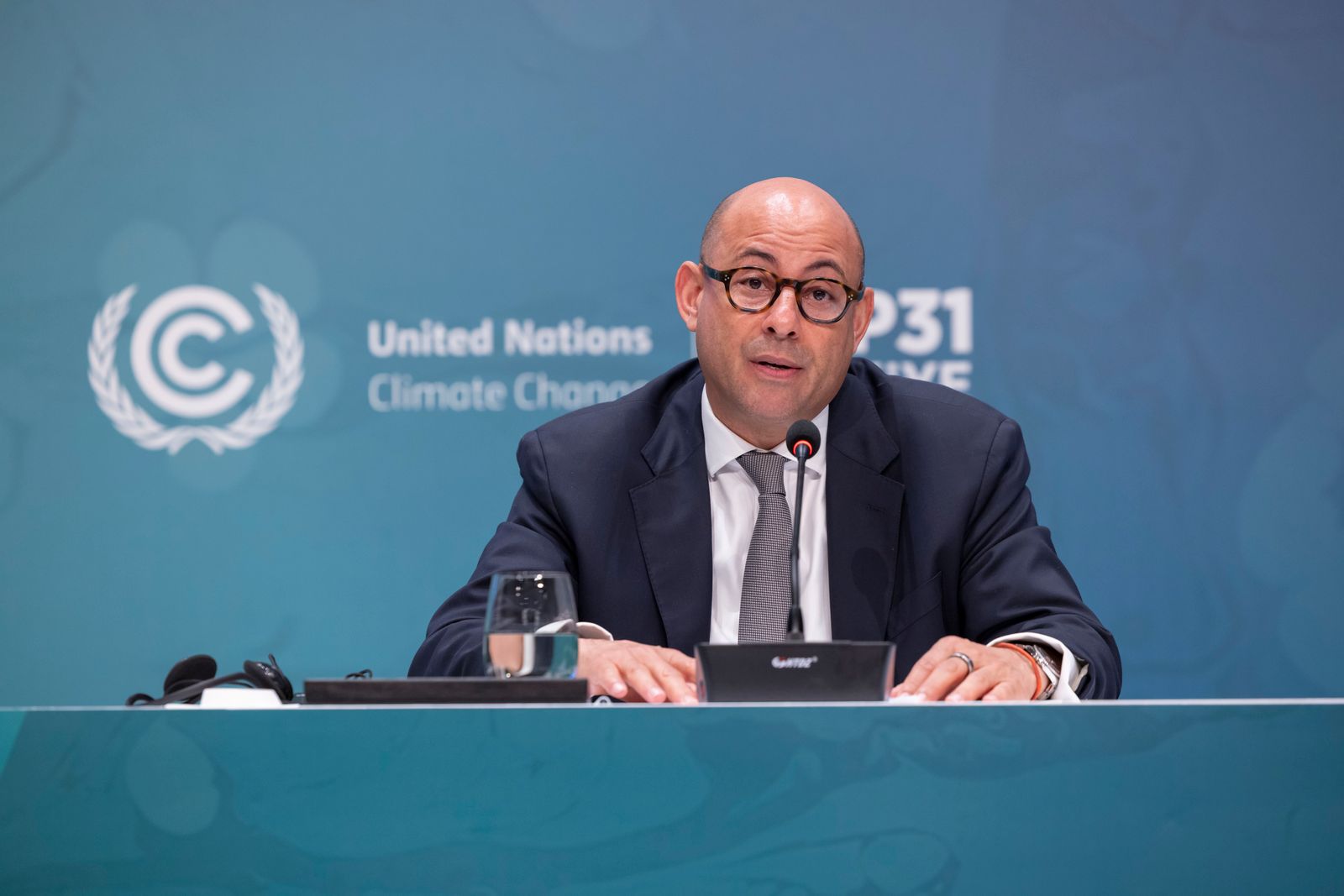


UN Climate Change Executive Secretary Simon Stiell has called for a “new era of implementation” in global climate action, warning that growing geopolitical instability must not derail progress made under the Paris Agreement.

Speaking at a press conference in Istanbul hosted by the COP31 President-Designate, Stiell said the upcoming COP31 summit in Antalya will take place “in extraordinary times,” marked by trade wars, political uncertainty and attacks on multilateral cooperation.
“We find ourselves in a new world disorder,” he said. “But climate action can deliver stability in an unstable world.”
Stiell thanked the Government of Türkiye for hosting the event and praised the country’s efforts toward zero waste and renewable energy expansion. He also acknowledged the leadership of Brazil (COP30 Presidency), Azerbaijan (COP29 Presidency), Australia, and the incoming COP31 Presidency.
A Third Era of Climate Action
Stiell outlined what he described as three eras of climate action. The first focused on identifying the problem, while the second—culminating in the adoption of the Paris Agreement in 2015—centered on building solutions.
“We are now entering the third era,” he said. “The era of implementation.”
According to Stiell, this phase must prioritize delivering on commitments made during the first Global Stocktake in 2023, including:
-
Doubling global energy efficiency by 2030
-
Tripling clean energy capacity by 2030
-
Transitioning away from fossil fuels in a just and orderly manner
-
Scaling up climate finance, particularly for vulnerable and developing countries
By the second Global Stocktake in 2028, he said, countries must be on track to meet these commitments and prepare stronger targets for COP33.
Clean Energy Investment Surges
Highlighting progress since the Paris Agreement, Stiell noted that global clean energy investment has increased tenfold over the past decade—from $200 billion annually to over $2 trillion.
“In 2025, clean energy investment was more than double that of fossil fuels,” he said. “Renewables overtook coal as the world’s top electricity source.”
He described the global energy transition as “irreversible,” even amid political resistance and economic uncertainty.
“Those stepping back from climate leadership are simply gifting this goldmine of new jobs and wealth to competitor economies,” Stiell added.
Response to US Withdrawal
Responding to a question about the United States’ recent withdrawal from the Paris Agreement and renewed focus on coal-fired power under President Donald Trump, Stiell said the door remains open for the US to return.
“The science and the economics are absolutely clear,” he said. “Renewables are the cheapest, cleanest mode of energy production moving forward. Renewables are cheaper than coal.”
He pointed out that global markets are already shifting decisively toward clean energy, with $2 trillion invested in renewables last year compared to $1 trillion in fossil fuels.
“No country is immune from the impacts of fossil fuel-generated pollution,” Stiell said, adding that climate action serves national self-interest in terms of economic growth, public health and energy security.
Climate Finance and Article 6
Reflecting on outcomes from COP29 in Baku, Azerbaijan, Stiell said the extended 33-hour negotiations were worthwhile.
Among key outcomes was an agreement to increase climate finance for developing countries from $100 billion to $300 billion annually, with a roadmap toward scaling that to $1.3 trillion per year. Parties also finalized rules on carbon markets under Article 6 of the Paris Agreement after a decade of negotiations.
“These outcomes will generate significant future finance for developing countries and help drive down emissions,” he said.
Hosting COP and Fossil Fuel Producers
Addressing concerns about Türkiye’s coal dependency as host of COP31, Stiell rejected any correlation between a host country’s fossil fuel production and the quality of summit outcomes.
He cited recent COPs hosted by fossil fuel-producing countries—including Egypt, the United Arab Emirates, Azerbaijan and Brazil—that nonetheless delivered significant decisions, such as the establishment of the Loss and Damage Fund and commitments to transition away from fossil fuels.
“There is every opportunity to deliver a very strong outcome signaling what this era of implementation looks like,” he said.
Climate Action as Security
Stiell framed climate action as central to global security, especially as climate-related disasters intensify.
“Climate action delivers lower energy bills, cleaner air, millions of jobs and energy access for over 700 million people who still lack it,” he said. “For any leader who is serious about security, climate action is mission critical.”
He concluded by emphasizing that climate cooperation is not a luxury in times of instability—but a necessity.
“More than ever, climate action and cooperation are the answer—not despite global instability, but because of it,” Stiell said.
COP31 will be held in Antalya, Türkiye, later this year.