

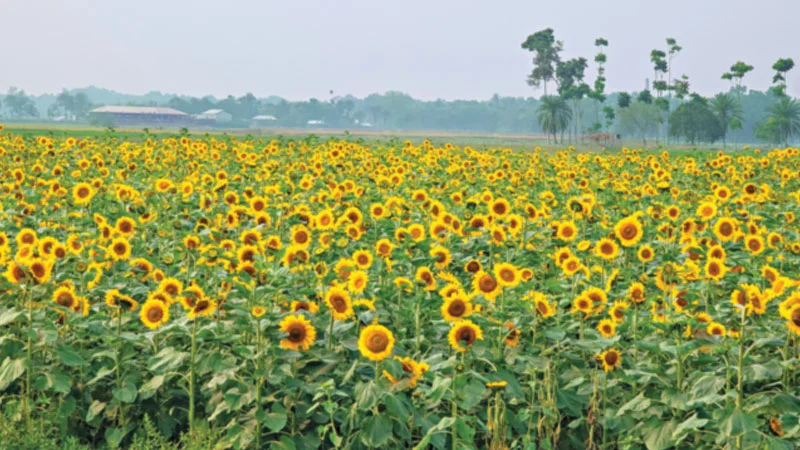



Vast stretches of land that once lay barren after the Aman rice harvest are now covered with bright yellow sunflowers in parts of southwestern Bangladesh, offering new hope for farmers struggling with soil salinity and climate change.
In Chanchra village of Narail Sadar upazila, farmer Kamrul Islam stood beside his field and pointed toward rows of blooming sunflowers swaying gently in the wind.
“Just a few years ago, nothing would grow here after Aman paddy,” he said. “During the dry season, salt rises in the soil, so we believed cultivating anything else would only increase our losses. Now the entire field is full of sunflowers.”
Across the districts of Narail, Khulna, Bagerhat and Satkhira, thousands of hectares of previously fallow land are being brought under sunflower cultivation. Farmers say the crop could transform not only their fields but also the rural economy in the coastal region.
Turning Fallow Land Productive
In the Khulna region, large areas of farmland remain unused from November to March due to salinity and limited irrigation water. According to the Department of Agricultural Extension (DAE), about 250,000 hectares of land remain fallow during the Kharif-1 season each year.
Over the past two years, sunflower cultivation has expanded under the Program on Agricultural and Rural Transformation for Nutrition, Entrepreneurship and Resilience in Bangladesh (PARTNER) project. The initiative provides farmers with seeds, fertilizers, pesticides and training.
As a result, fields that once remained empty for months are now producing sunflower crops.
A Crop with Promise
Kamrul Islam cultivated the BARI Sunflower-3 variety on two acres of land this season. Developed by the Bangladesh Agricultural Research Institute, the variety has shown promising results in saline soils.
“Each flower can produce nearly one kilogram of seeds,” Kamrul said. “I have never seen such yields before.”
In Phultala upazila of Khulna, several farmers jointly cultivated sunflowers on two acres of land this year.
“This is our first time growing the crop,” said farmer Rezaul Karim. “If the yield remains good, we may earn nearly double the profit compared to rice.”
Farmers say another advantage is that sunflower requires relatively little irrigation, making it suitable for areas facing water shortages.
Low Cost, High Returns
Agricultural officials estimate that cultivating sunflowers on one acre costs around 3,500 Bangladeshi taka (about $32). Farmers can earn more than 25,000 taka from the harvest.
On average, one bigha of land yields 7–8 maunds of sunflower seeds. From each kilogram of seeds, about 400 grams of oil can be extracted. This means a single bigha could produce roughly 130 liters of edible oil.
In addition to oil production, the leftover seed cake can be used as livestock feed, while dried stalks can serve as fuel.
Reducing Import Dependence
Bangladesh currently imports most of its edible oil, with only about 15 percent produced domestically. According to agricultural officials, the country spends around 160 billion taka annually on edible oil imports.
“Expanding sunflower cultivation on fallow land could significantly reduce this dependency,” said Md. Mosaddek Hossain, a senior monitoring officer with the PARTNER project in the Khulna region.
Climate-Resilient Farming
About 57 percent of farmland in the four districts of Narail, Satkhira, Khulna and Bagerhat is affected by salinity, according to the Department of Agricultural Extension.
While land is considered saline at about 8 deciSiemens per meter (dS/m), sunflower plants can tolerate salinity levels of up to 15 dS/m, making them suitable for coastal areas vulnerable to climate change.
The government has distributed seeds and fertilizers to more than 10,000 farmers as part of its efforts to expand cultivation. Currently, sunflower farming is taking place on about 1,600 hectares of land across the region.
Agriculture officials say that if the region’s fallow land can gradually be brought under cultivation, sunflower along with other crops such as mung beans and green manure plants could further improve soil fertility and farmers’ incomes.
“Farmers are already seeing encouraging results,” said project coordinator Abul Kalam Azad. “If the initiative expands, sunflower could become an important crop for the coastal region and help strengthen the country’s edible oil production.”