
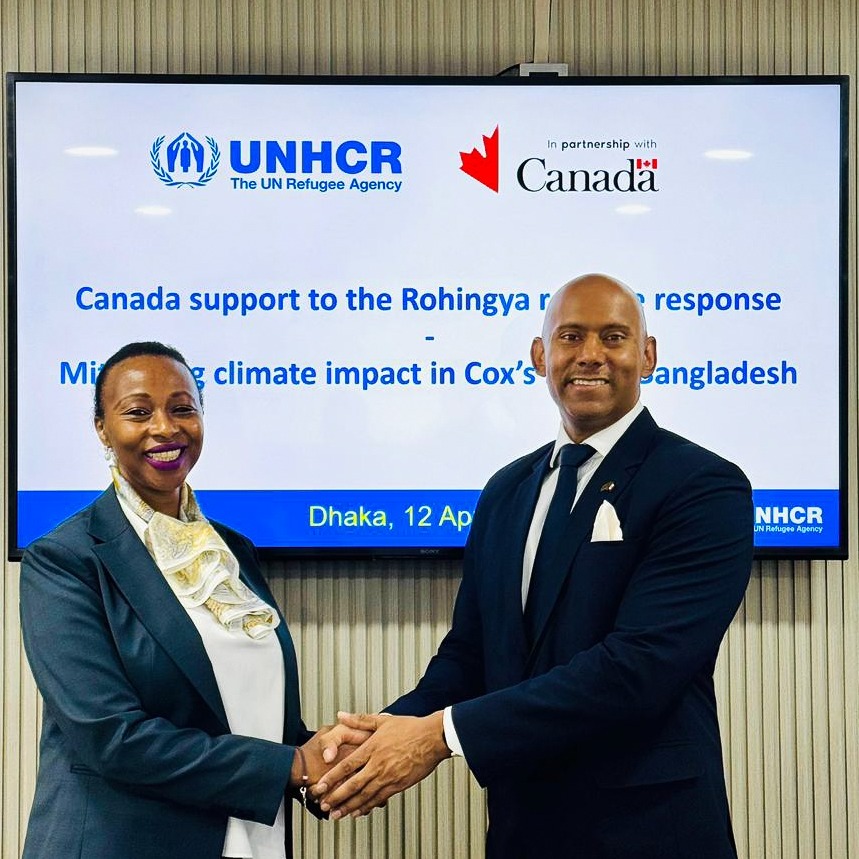


Canada has announced a contribution of CAD 10 million to support the provision of clean, safe and sustainable cooking fuel for nearly 1.2 million Rohingya refugees living in camps in Cox’s Bazar.

The funding, channelled through UNHCR, the UN Refugee Agency, and the International Organization for Migration (IOM), will ensure continued access to liquefied petroleum gas (LPG) for refugee households. The initiative aims to reduce reliance on firewood, protect the fragile environment surrounding the camps, and improve safety, health and dignity—particularly for women and children.
Canadian High Commissioner to Bangladesh Ajit Singh said the contribution reflects Canada’s continued commitment to the Rohingya response. He noted that the climate-responsive support would help curb deforestation and carbon emissions in one of Bangladesh’s most environmentally vulnerable regions, while also reducing risks associated with firewood collection.
Cox’s Bazar, which hosts more than a million Rohingya refugees, remains highly exposed to climate-related hazards including floods, landslides, cyclones and fires. Since the introduction of LPG distribution in 2018, firewood use among refugee households has dropped by around 80 percent, preventing an estimated 407,000 tonnes of carbon dioxide emissions annually.
UNHCR Deputy Representative in Bangladesh Juliette Murekeyisoni said the support comes at a critical time as the Rohingya crisis enters its ninth year, describing it as one of the world’s most protracted displacement situations compounded by climate vulnerability. She emphasized that sustained international support remains essential to ensure refugees can live with dignity while efforts continue toward safe and voluntary repatriation.
Giuseppe Loprete, acting Chief of Mission for IOM in Bangladesh, said access to safe and reliable energy is vital for families who have endured years of hardship. He added that Canada’s contribution would help reduce health risks, limit environmental damage, and protect local forests and biodiversity.
The funding is expected to support LPG access for approximately 243,500 refugee households and help conserve up to 10,700 hectares of protected forest in Cox’s Bazar. It will also contribute to stabilizing slopes, reducing landslide risks, and minimizing human-wildlife conflict in ecologically sensitive areas.
Officials say the LPG programme has already improved indoor air quality in the densely populated camps and reduced household expenditure on cooking fuel, making it a key component of the ongoing humanitarian response.