

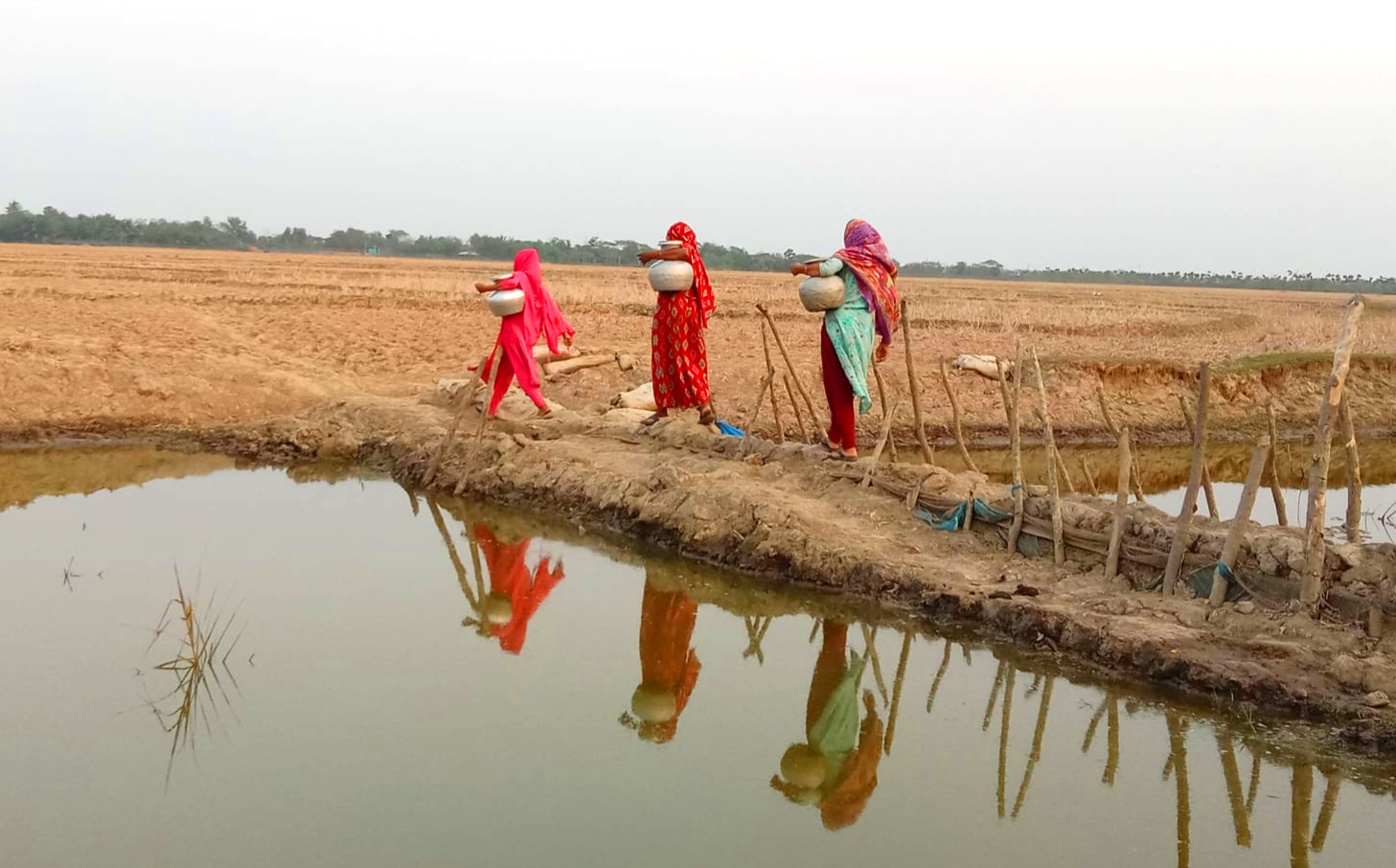


A severe shortage of safe drinking water has emerged across the coastal Regions of Khulna as the dry season begins and temperatures rise. Increasing salinity has made tube-well water largely undrinkable in many area, while declining groundwater levels have worsened the situation, forcing people—especially in remote communities—to rely on pond water.

In Koyra Upojela Maheshwaripur Union, residents of at least 10 villages depend on ponds for drinking water. Women members of households often walk long distances carrying pitchers to collect water. Similar conditions prevail in South Bedkashi, Bagali, Maharajpur and Amadi Union, where freshwater sources are being depleted due to salinity intrusion.
Shamim Arefin, Executive Director of water research organization ACESD, said around 22 percent of people in Khulna, 15 percent in Bagerhat, and 13 percent in Satkhira are currently facing a drinking water crisis. He attributed the worsening situation to climate change-induced salinity, unplanned groundwater extraction, falling water tables, expansion of shrimp farming, and the filling of wetlands for infrastructure development.
According to the Department of Public Health Engineering (DPHE), groundwater levels drop by two to two-and-a-half feet during the dry season, rendering even deep tube-wells ineffective in many areas.
Maheshwaripur Union Chairman Shahnewaz Shikari said, “Due to salinity, tube-well water is not suitable for drinking. People in 11 villages are using open pond water. Some households store rainwater in plastic tanks, while others collect water from distant sources.”
The crisis is also intensifying in Khulna city, home to nearly 1.5 million people across 31 wards. The daily demand for water stands at around 240 million liters, but the Khulna Water Supply and Sewerage Authority (WASA) can supply only 80 to 110 million liters through its Pipeline network. areas such as Nirala, Tutpara and Nazirghat are experiencing acute shortages as groundwater levels fall, reducing pumping capacity.
Sirajul Islam, a resident of Sonadanga, said, “The crisis began early this dry season. We often have to travel long distances, sometimes by rickshaw, to collect water.”
To address the issue, DPHE officials said plans are underway to introduce mini water supply systems in areas where tube-well water is unsafe. Meanwhile, Khulna WASA officials stated that once Phase-2 of the water supply project is implemented, pipeline connections will be expanded to wards 1–16 of the city, which is expected to significantly ease the crisis.